

Controlling Costs In An Inflationary Economy
Inflation is no longer an occasional economic ripple—it has become a defining business challenge, steadily eroding margins and squeezing working‑capital needs. When prices for raw materials, labour, and overhead climb month after month, savvy organizations must go beyond simple cuts to implement sustainable cost controls that preserve value and support long‑term growth. Controlling costs in an inflationary environment demands a multi‑dimensional approach: one that balances disciplined spending with strategic investments, leverages data to pinpoint inefficiencies, and aligns cross‑functional teams around shared goals. Additionally applying multi-dimensional strategies such as precise activity‑based costing, strategic supplier partnerships, lean/process optimization, and working‑capital tactics allow organizations to preserve margins, maintain liquidity, and invest in growth even as costs rise.
Applicable Industries
All sectors
Notably, Manufacturing | Retail | Hospitality | Healthcare | Energy
In an inflationary economy, every dollar counts, and the first step is achieving granular visibility over your cost structure. Rather than relying on high‑level budget categories, companies should drill down to activity‑based costing—tracing expenses to specific processes, product lines, or customer segments. By mapping each cost driver, from raw‑material procurement to distribution logistics, finance teams can distinguish between controllable and non‑controllable costs. This precise understanding makes it possible to target optimization efforts where they will yield the greatest impact without compromising core capabilities.
Consider a manufacturer faced with rising steel and energy costs. By analyzing consumption data at the production‑line level, the company discovers that certain product runs consume disproportionate energy during off‑peak hours. Armed with this insight, operations can reschedule high‑energy runs to daytime slots when energy rates are lower or deploy energy‑management software to throttle consumption. Such targeted measures deliver real savings, whereas across‑the‑board cuts—like uniformly reducing run times—would risk missing critical deadlines and damaging customer satisfaction.
Activity‑Based Costing for Precision Targeting
Activity‑Based Costing (ABC) decomposes overhead into discrete activities and cost drivers, revealing where inflation bites hardest. A manufacturer facing 12 percent energy‑cost inflation used ABC to discover that two production stages consumed 60 percent of total energy spend. Targeted process changes in those stages yielded 20 percent energy savings, offsetting the inflationary increase.
When inflation bites, supplier costs inevitably rise, but the manner in which you engage your vendors can make a significant difference. Leading organizations shift from transactional purchasing to true partnerships, negotiating volume discounts, fixed‑price contracts for core inputs, or price‑adjustment clauses tied to agreed indices. At the same time, dynamic sourcing—maintaining relationships with multiple vetted suppliers across geographies—mitigates the risk of sudden price shocks or supply disruptions. In practice, a retail chain might secure a baseline supply of packaging materials under a fixed‑rate agreement while keeping two alternate suppliers on standby for spot purchases, ensuring continuity and price flexibility.

Sustainable cost control requires more than tools and processes—it demands a culture in which every team member sees cost optimization as part of their role. Clear, measurable metrics such as cost per output unit or variance against rolling forecasts should be communicated transparently across the organization. Incentive programs can recognize individuals and teams who deliver cost‑saving ideas or consistently meet efficiency targets. Regular “optimization forums” that bring finance, operations, procurement, and sales leaders together foster cross‑functional collaboration and continuous sharing of best practices. Over time, this cultural shift embeds cost consciousness into daily routines rather than treating it as a monthly / quarterly exercise.
Inflation intensifies the imperative to eliminate waste across operations. Lean methodologies—originating in manufacturing but now applied broadly—offer a proven framework for streamlining workflows, reducing rework, and minimizing inventory carrying costs. For a multi‑location hospitality business, this could mean standardizing kitchen procedures to prevent over‑preparation, implementing just‑in‑time inventory replenishment for perishables, and training staff in waste‑minimization techniques. Over time, these process improvements compound: reducing food‑cost percentages, labor‑expense variances, and spoilage losses, all of which cushion the impact of rising input prices.
Inflationary pressures often translate into higher working‑capital requirements as inventory values and receivables grow. Proactive working‑capital management becomes a vital element of overall cost control. Techniques such as dynamic discounting—negotiating early‐payment discounts with suppliers—can improve cash‑flow timing while reducing procurement costs. On the receivables side, offering small incentives for prompt customer payments accelerates collections and lowers days‑sales‑outstanding. Together, these measures preserve liquidity, reducing the need for high‑cost financing that would further inflate expense ratios.
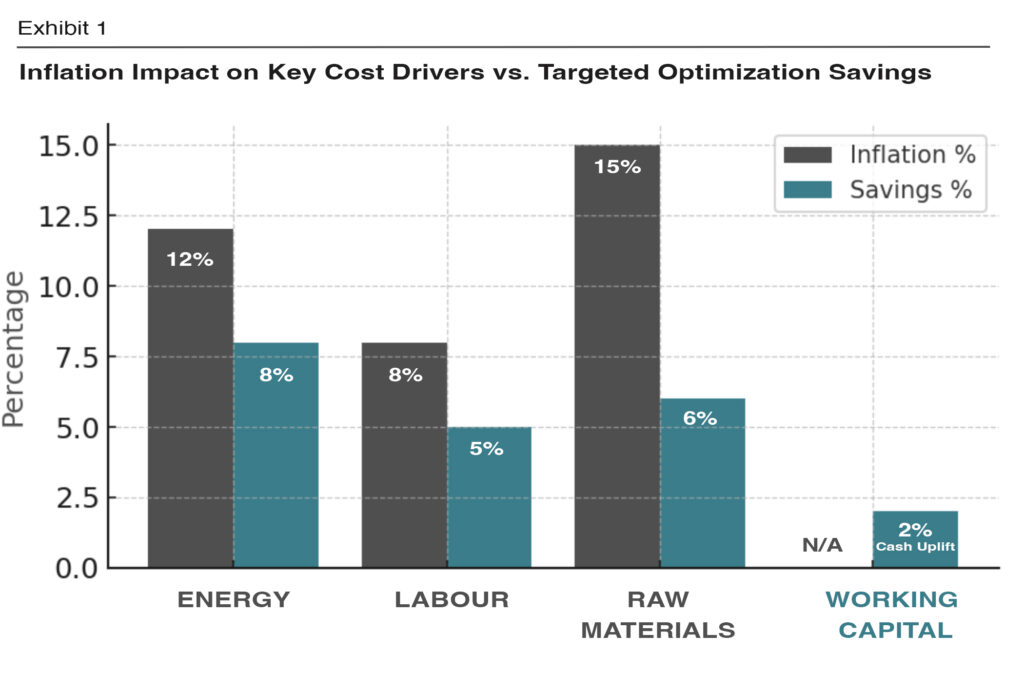
As inflation continues to reshape cost structures across industries, organizations must evolve their approach from reactive cuts to proactive, strategic cost control. By harnessing data for pinpoint accuracy, forging agile supplier partnerships, streamlining processes with lean and automation, and cultivating a cost‑conscious culture, businesses can protect margins and invest in future growth—even when prices are rising.
Have questions or need a tailored cost‑control roadmap for your business? Reach out to The Phantos Group on WhatsApp: +1‑876‑375‑8822.
References:
- Harvard Business Review. “Precision Pricing When Inflation Is Rising.”
- McKinsey & Company. “Pricing during inflation…”
- Throughput world. “Dynamic Buffer Inventory Planning…”
Receive updates on new articles