
In today’s hyper‑uncertain business landscape—where supply‑chain breakdowns, geopolitical shifts, and technological disruptions occur with increasing frequency—relying on a single “most likely” forecast is no longer sufficient. Scenario planning offers a powerful alternative by asking not “What will happen?” but “What could happen?” and then building robust strategies to thrive in each potential future. This multidimensional approach expands strategic vision, exposes hidden risks that single‑point forecasts miss, and equips leadership teams with ready‑to‑execute playbooks when circumstances change.
For a multi‑location retail chain operating in Kingston, Montego Bay, and Ocho Rios, scenario planning might model three distinct futures: a post‑pandemic tourism boom, a slow recovery, and a prolonged downturn caused by external shocks. In the “boom” scenario, management pre‑positions inventory buffers and hires seasonal staff; in the “slow” scenario, they negotiate flexible supplier terms and deploy targeted promotions; in the “downturn” scenario, they tighten working capital and explore new local sales channels. By stress‑testing strategies across these narratives, the chain reduces stock‑out events and cuts inventory‑holding costs, turning uncertainty into a competitive advantage.
The process begins with clearly defining the focal issue—such as next year’s inventory needs—and setting a time horizon for analysis. Teams then identify the most critical factors that could influence outcomes, from raw‑material price swings to consumer‑confidence shifts, and select the few uncertainties with the greatest impact and ambiguity. They craft rich, qualitative storylines—“Demand Surge,” “Supply Disruption,” or “Regulatory Shift”—and pair these narratives with quantitative projections for revenue, costs, and cash flows. Finally, leadership rigorously tests existing strategies against each scenario, refines resource allocations, and creates explicit “if‑then” playbooks, deciding in advance that if raw‑material costs rise by twenty percent, secondary suppliers will be activated and pricing strategies adjusted accordingly.
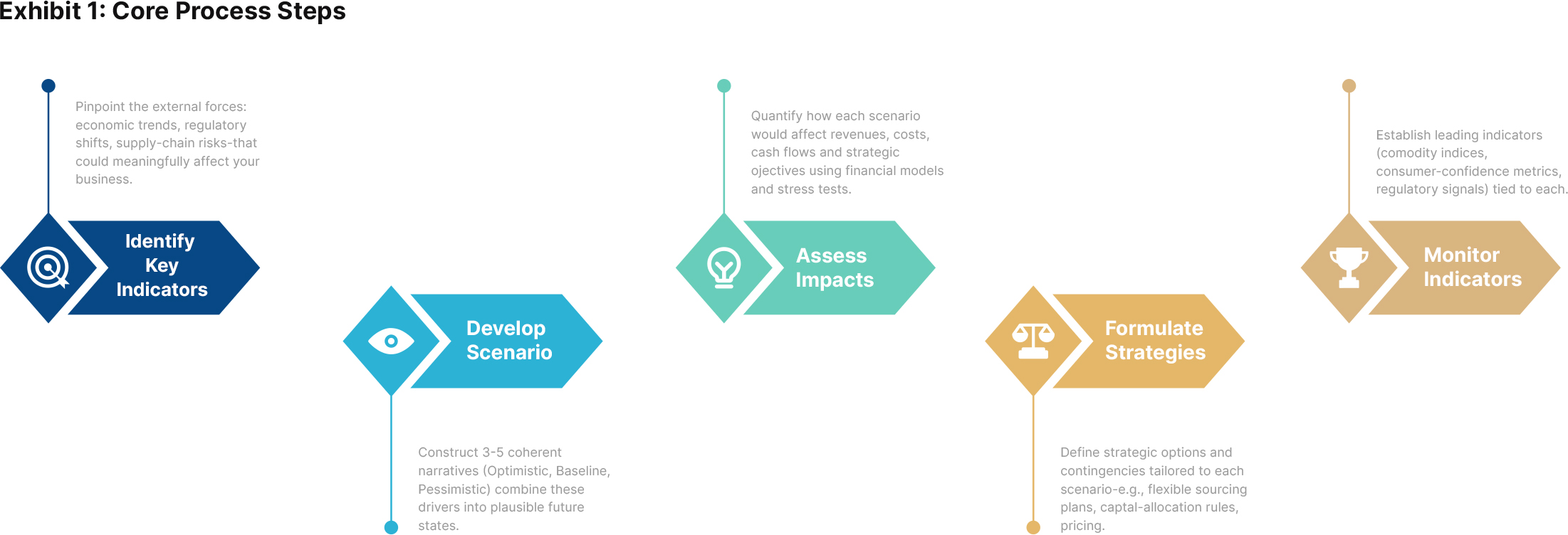
Across industries, the benefits of this approach are clear. In hospitality, hotels simulate varying occupancy scenarios to optimize staffing, procurement, and marketing spend, improving labor‑cost efficiency without sacrificing service quality. In manufacturing, factories that depend on imported components develop contingency playbooks for both partial delays and full supplier shutdowns to reduce production stoppages. By systematically exploring multiple futures, organizations shift from reactive firefighting to proactive resilience.
To avoid common pitfalls—over‑complexity, siloed planning, and static outputs—limit planning to three or four well‑defined narratives, involve cross‑functional teams throughout the process, and schedule regular refreshes at least quarterly. Institutionalizing scenario planning also requires clear governance, dedicated software for data integration and visualization, and training so that every stakeholder can interpret and act on scenario insights.
By transforming ambiguity into actionable insight, scenario planning empowers decision‑makers to anticipate risks, align resources, and communicate with confidence. In an era where change is the only constant, mastering scenario planning is not optional—it is a strategic imperative for any organization aiming to thrive.
Have questions or need support applying these insights to your business? Reach out to The Phantos Group on WhatsApp: +1‑876‑375‑8822.
Receive updates on new articles